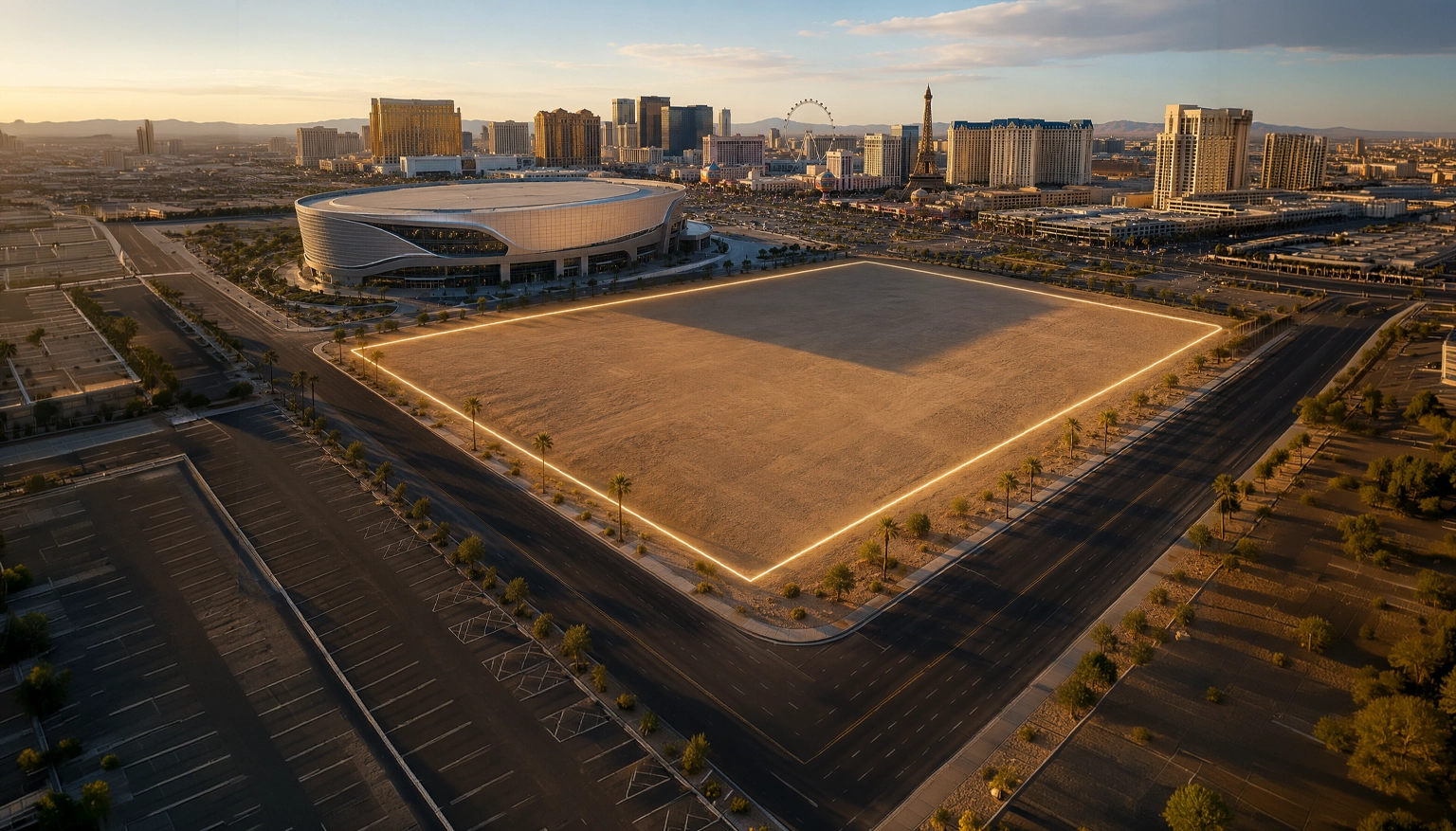
Chetak Development has completed a land assembly worth nearly $30 million for the proposed Las Vegas Diamond Arena, an NBA-ready venue intended to strengthen the citys case for professional basketball expansion. The final piece was a roughly $23 million purchase of a 3-acre parcel from Desert Loan Acquisitions, completing an 11-acre site at the northeast corner of Las Vegas Boulevard and Four Seasons Drive. A separate $5.1 million deal for an adjacent 0.64-acre parcel, tied to a planned private aviation terminal, remains in escrow with Buccaneers Investments.
The project envisions a 21,000-plus-seat arena with direct access to Interstate 15 and Interstate 215, visibility to more than 60,000 daily vehicles, proximity to Harry Reid International Airport, and roughly 19,000 parking spaces including VIP capacity. The private aviation terminal would connect to the arena through an underground tunnel intended for use by a future NBA team, ownership groups and high-value guests. None of this is tied to a confirmed franchise; it is a speculative, privately funded bet designed to remove site risk ahead of any formal league decision.
That bet comes as Las Vegas has spent the past decade building the infrastructure case for major league sports. The city already hosts the NHLs Golden Knights, an NFL Super Bowl, Formula 1s Las Vegas Grand Prix and WNBA preseason activity, and NBA commissioner Adam Silver has repeatedly named Las Vegas and Seattle as the leagues leading domestic expansion candidates. What Las Vegas has lacked, relative to markets with an existing or shovel-ready venue, is a fully resolved arena site. This transaction closes that gap without league involvement or public subsidy, which changes the risk calculus for both the city and the league.
The strategic logic runs in two directions. For the developers, assembling the land now, ahead of any expansion award, is a way to make Las Vegas the lowest-friction option when the NBA formally opens an expansion process, effectively pricing in a decision the league has not yet made. For the league, it removes one of the standard objections to awarding a franchise to a market: the absence of a bankable, permitted site. The addition of a private aviation terminal is also a signal about how arena economics are evolving. Rather than treating a venue purely as a game-day asset, the developers are building adjacent infrastructure aimed at premium hospitality and high-net-worth access, a model closer to luxury real estate development than traditional arena financing.
The scale of the land investment, just under $30 million, is small relative to the expansion fees the NBA is expected to command for a new franchise, which recent franchise sale prices suggest could run into the billions. But as a credibility signal to the league, it is disproportionately effective: it demonstrates committed private capital and a de-risked site years before any formal bid process concludes.
For the wider industry, this raises the bar for other expansion hopefuls. Markets competing for the NBAs next franchise slot, and cities pursuing other leagues expansion plans, will increasingly need to show comparable infrastructure commitments rather than conceptual proposals. It also reinforces a broader trend of private capital moving ahead of league decisions to shape the field of viable candidates, effectively outsourcing part of the site-selection risk that leagues have traditionally managed themselves.