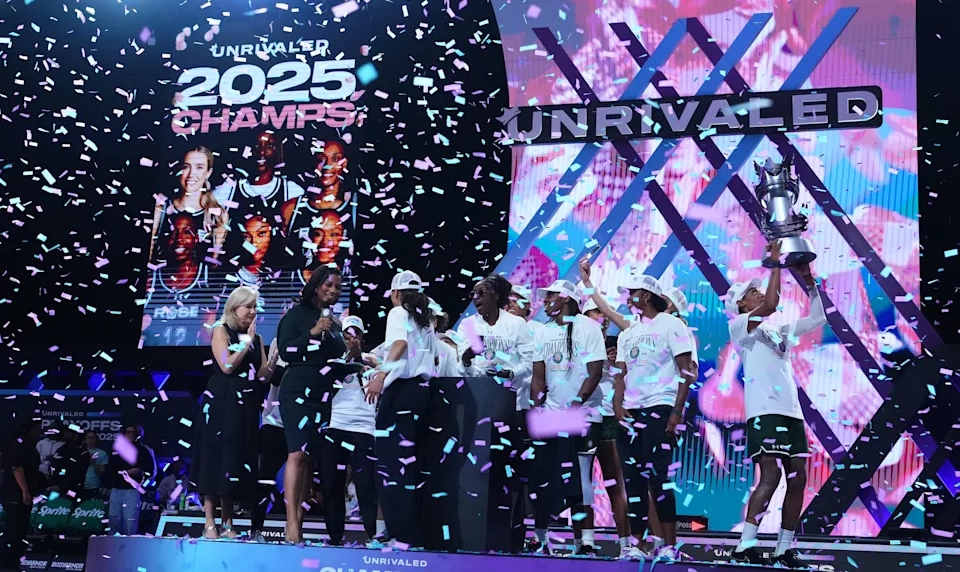
Unrivaled, the three-on-three womens basketball league co-founded by Breanna Stewart and Napheesa Collier, announced on 26 August that its Series C fundraising round closed above its $100 million target and was oversubscribed, setting a league valuation of $650 million. The round was led by Ten Pillars Sports Fund, which is backed by UC Investments, with participation from Bessemer Venture Partners, Carmelo Anthony, Geno Auriemma, Alex Morgan through Trybe Ventures, Ashton Kutcher, Jenny Just, Dan Rosensweig, Trae Young and the Berman family.
Founded in 2023 and launched in 2025, Unrivaled offers WNBA players a domestic offseason alternative to playing overseas, on a compressed schedule staged in a single location. Its second season expanded to eight clubs and 54 players and produced sold-out dates in Philadelphia and Brooklyn. The leagues third season begins in January 2027 on TNT Sports under a six-year media agreement reported to be worth a nine-figure sum, in which Warner Bros. Discovery holds both an equity position and an opt-out after three years. Players collectively remain the largest shareholder group; the league says the player equity pool has grown more than 550 per cent since inception and is now worth approximately $200 million. Chief executive Alex Bazzell framed the round around that ownership structure, saying the league was built by players and for players.
The valuation is striking precisely because the television trend runs the other way. Season two opening-weekend games averaged 175,000 viewers on TNT and truTV, down from 312,000 for the season one opener, with truTV-exclusive games falling as low as the tens of thousands against NFL playoff and college football competition. Investors are therefore not pricing linear audience. They are pricing the equity structure, the live-event economics and the scarcity of investable assets in womens sport. Merchandise sales rose more than 50 per cent year over year and ticket revenue rose 40 per cent for the same opening weekend, which is the evidence base the round was built on: a small, high-intensity, high-yield direct relationship with fans rather than a mass broadcast audience.
The industry implication is that player equity has moved from a talking point to a financing instrument. By making athletes the largest shareholder bloc, Unrivaled converted the recruitment problem that kills most challenger leagues into a retention mechanism, and it did so without matching WNBA salary structures. A roughly $200 million player pool also creates a benchmark that will surface in the next round of WNBA collective bargaining and in every new womens property seeking capital. The risk is unchanged and well understood: a nine-figure media deal with an opt-out after three years is a soft floor, not a foundation, and if audience figures do not recover before Warner Bros. Discovery reaches that decision point, the $650 million mark will need to be defended on commerce and attendance alone.